


What if, instead of using its vast industrial might to become the world’s dominant imperial power, the United States had developed an equally strong military whose combat capacity could be primarily used for good?
After the Second World War, the United States rebuilt much of the European and Asian economies, including those of their wartime adversaries Germany and Japan, and the countries they invested in largely became prosperous, peaceful nations, as well as their closest allies.
The same cannot be said of the United States themselves, whose motives for building a large middle class and a network of strong capitalist democracies were to undermine the spread of communism from their arch-rivals, the Soviet Union, and thus win over the hearts and minds needed to prevail in the Cold War.
With the Soviet Union defeated and Communist China being essential to Capitalist America, the need for a strong middle class has all but disappeared. The oligarchy needs a weak and increasingly defeated middle class to consolidate their wealth and power. They also need a strong military to deal with all the new adversaries they have created for themselves in propping up their own economic excesses, imposing their will overseas, and ultimately keep their population subdued.
A country with strong social programs, universal healthcare, equal access to education, full employment and a vibrant middle class cannot recruit vast number of volunteers to its armed forces. Trading killing and potentially dying for the possibility of going to university or seeing a doctor is less of a good deal if you can go to university or see a doctor without enlisting.
Countries with those strong social programs either have mandatory conscription or small, professional militaries where their members serve primarily because they want to serve. Every encounter I have had with Canada’s armed forces has shown people who genuinely want to be there, who see it as a profession which offers them a sense of purpose.
The United States has an immense military designed to project imperial power and protect and enrich the oligarchy, where conscription is not done directly through the draft, but through lack of options for vast segments of the population. Where vast, expensive weapons programs are intended to create vast industrial profits, where enemies are needed to justify the expenditures.
What if there was a compromise to all this? With the forest fires raging across Canada and the nitwit in the White House accusing Canada of blowing smoke his way, I am left wondering if there had been a third way. One in which the oligarchs could have made their money, the United States could have projected their power, the country could have universal healthcare and social programs in a way that did not tie military service to their access, where service was not primarily about being part of a killing machine, where the only access to the benefits of socialism are accessed by fighting for the owners of capitalism.
There is a way for the country to project immense power throughout the world without also creating enemies, where the sight of the American military arriving could have been generally seen as a positive more often than as an invader or interferer. And it’s one they already did, however briefly, and regardless of their motivations that may not have been entirely altruistic. The Marshall plan in Europe and the similar efforts at rebuilding in Japan showed what they are capable of projecting and doing. The results speak for themselves in the countries addressed.
In 1948, as the Cold War heated up and the Soviet Union tried to prevent western access to Berlin, which was within East Germany but divvied up among the conquering victors, the Americans launched an airlift to use military transports to bring food and basic supplies to the city to keep it afloat. For 15 months, American and British aircraft brought in 13,000 tons per day of supplies to the city, across over 200,000 flights, in what became known as the Berlin airlift.
The American military has a budget approaching one trillion dollars per year. It is such a vast number that it is impossible to comprehend. They have weapons platforms that cost hundreds of billions of dollars, with the F-35 lifecycle cost alone exceeding two trillion dollars. Individual warships have populations greater than three-quarters of the country’s municipalities.
The country has 76 B-52 Stratofortresses in service, 19 B-2 Spirit stealth bombers, 41 B1-B Lancer bombers. They have thousands of other combat aircraft. They have around 900 assorted cargo aircraft without even counting their helicopters, capable of transporting large numbers of people in difficult circumstances.
None of it is set up for to project positive power, to serve a good that does not involve attacking a ‘bad’.
Imagine, now, for a moment, that the this same vast military might had been used the way it was for 15 months between 1948 and 1949 throughout its history. When there was a humanitarian crisis or a natural disaster, that the American military-industrial complex turned its profitable weapons-development platforms and use into assistance, showing the great power of the great capitalist industrial economy to the world without stealing resources, or killing or displacing anyone in the process.
What would it look like? The United States Army Corps of Engineers has spent over a century building civilian infrastructure from the Panama Canal to the Library of Congress. In the 1960s they built Afghanistan’s ring road. There is plenty of precedent for doing good.
Mass evacuations following natural disasters would be cheaper than vast long distance bombing raids, and the arrival of the air force and navy in those circumstances would be a welcome sight rather than a concerning one. Each C-5 Galaxy transport aircraft can hold 350 people comfortably and the US has over 50 of them. At just one flight per day per aircraft that type alone could move 18,000 people per day out of harm’s way.
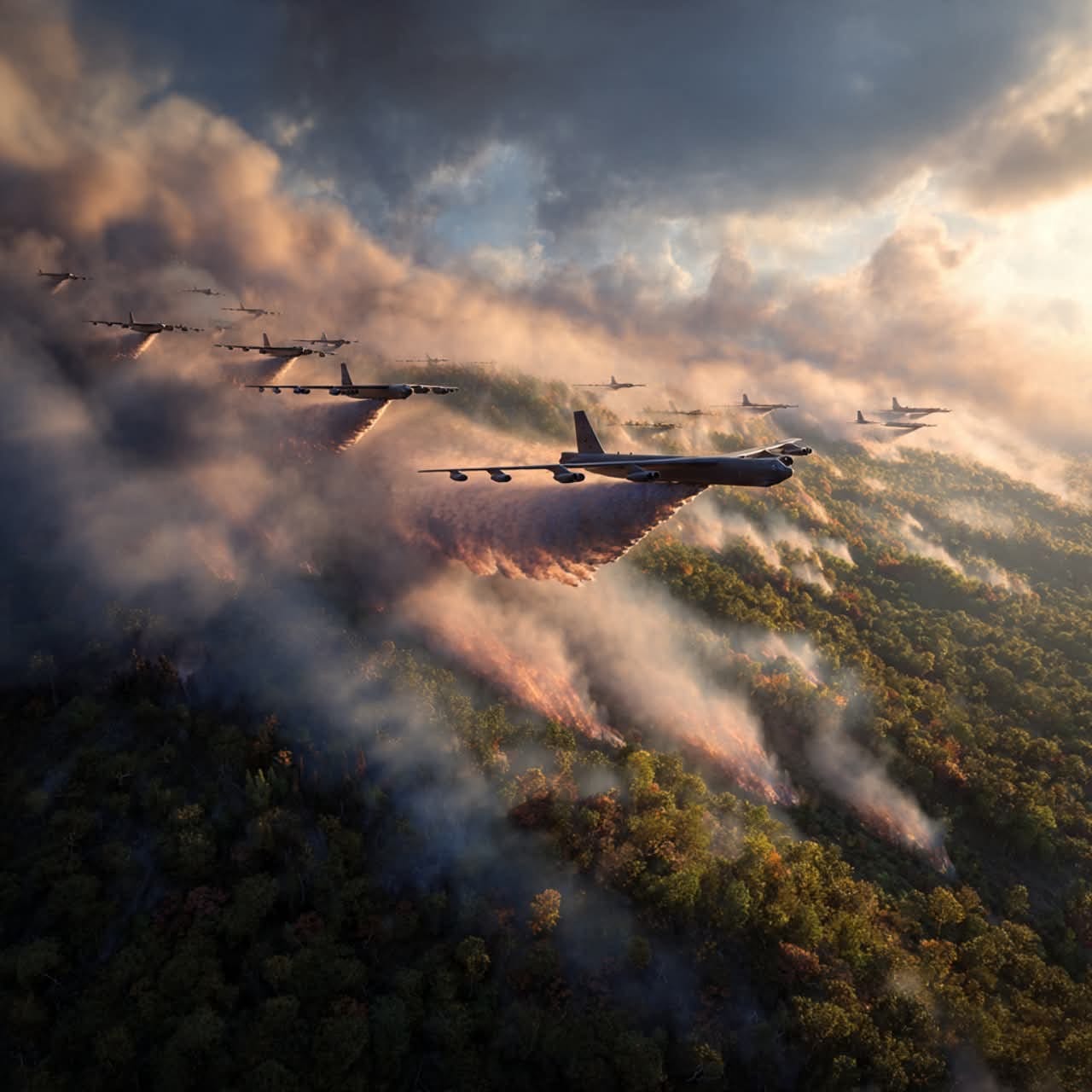
In events like this month’s vast wildfires, imagine bomber streams coming in dropping vast quantities of fire retardant. A B-2 can carry 27 metric tons of weapons. A B-52 can carry 32 metric tons. A B-1B can carry 34 metric tons. What if those weapons were precision-guided canisters of fire suppressing foam? Each B-52 could carry 32,000 litres of water instead of a giant bomb. It would be much slower than a standard CL-415 amphibious water-bomber, but it would more than make up for it with capacity, range, and sheer numbers, and does not preclude the use of those purpose-built aircraft. What if the thousands of smaller, high speed fighters and attack aircraft could rapidly react to such incidents around the world and stop fires rather than starting them?
The military would still have their enemies — but they would be the disasters and challenges that are the common enemy of all the people. The oligarchs would still have their vast weapons platforms, and the industrial profits that come with them. A military that shows up to help rather than to impose would be a welcome sight, something to be a part of for reasons greater than being the only way to gain access to government social programs.
In foregoing all but the most essential military operations in the traditional sense, the doctrine of shock and awe could simply be the doctrine of awe. The projection of American power would be one of good will, not one of imposed will. The arrival of the vast imperial machinery of the United States military would be welcomed, not feared. Where the good will generated toward the United States would result in more open markets and better relations, where other countries and populations would want to trade with the friendly giant instead of having to.
The trouble, though, and the reason the country will never see its own potential in this way is simple. Helping others is socialism. Killing them is capitalism.