


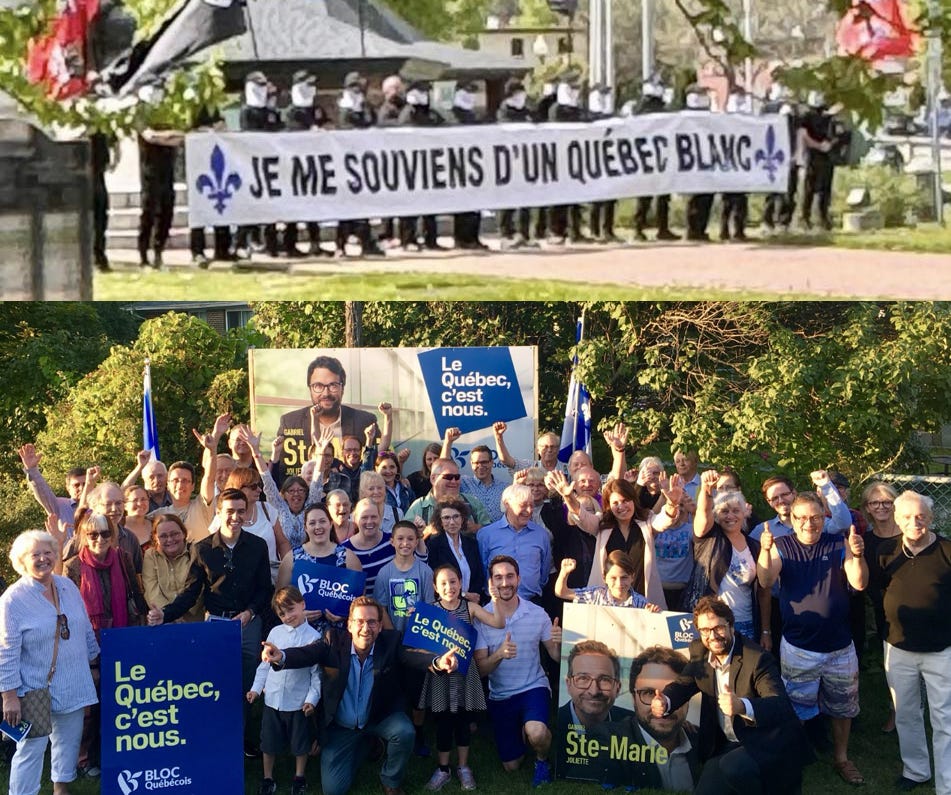
Quebec’s nationalists are in overdrive trying to dissociate themselves from an overtly white-supremacist rally in Shawinigan over the weekend — but the slogan “I remember a white Quebec” is not far from the Bloc’s own “Quebec is us” campaign featuring almost exclusively white francophones, and their anger is profoundly disingenuous.
It was the Bloc’s own social media post disavowing the racist slogan of the protest that first crossed my news feed. Then the deeply separatist St Jean Baptiste society’s post condemning, without irony, all forms of intolerance and racism. The leaders of the Parti Québécois, the premier, and every Quebec nationalist ever to sow the divisions underlying the slogan jumped on the bandwagon over the weekend. Their own urgency to dissociate from a slogan that did not mention them helped it spread far more widely than it otherwise would have.
In 2015, I ran in the rural Quebec riding in which I had grown up, believing that the orange wave of 2011 had proven that the province was finally ready to move on from this type of nonsense and discuss real issues. That, though fluently bilingual, I was and would always be, and be seen as, an anglophone, but that it would finally no longer matter. I was born in Sainte-Agathe-des-Monts and even as I had lived in other places, I had always been proud to be a Quebecker, with my own heritage documented in the province going back to 1647.

I won my seat in that election by a thin margin. A week earlier, I would probably have lost to the collapsing NDP. A week later, I would probably have lost to the rising Bloc. But I was sworn in on November 10th, 2015 and received an overwhelmingly positive reception across a riding that had spent a generation being among the safest Bloc seats in the province. We got to work showing that the federal government could, in fact, do something.
Through my first years in office, the Bloc was a dead issue. It had all but collapsed. The small caucus of 10 people itself cleaved into two caucuses. Quebec society had moved on, and we were fixing badly overdue problems like rural telecommunications infrastructure that were leaving the regions behind. There were still overtones of the nationalist debates, of course, especially around secularism in the public service as the provincial government fanned the flames over visible religious symbols in the public service. It hadn’t gone fully away. But locally, I could do the job I was elected to do — bring the concerns of my community to Ottawa, and get them addressed.
Then the Quebec National Assembly, nervous across party lines about a federal government actually achieving for Quebec, had their ridiculous ‘Bonjour-Hi’ motion. The province was bending over itself to explain how being greeted with a bilingual question, leaving the door open to the customer’s choice of language of service, would destroy Quebec society and set French back generations.
Late one evening in that period, without premeditation, I flippantly said ‘bonjour-hi, madame la présidente’ at the start of a speech in the House of Commons on campaign finance reform, and found myself in a media quagmire of my own making, with a new-found target on my back.
The Bloc’s newly elected leader, Yves-François Blanchet, meanwhile, was bringing the Bloc movement back from the brink. The Conservative propaganda machine had done a number on Justin Trudeau’s reputation, turning the once-popular prime minister into a political albatross. Immigrants crossing into Canada at Roxham Road were fanning the flames of nationalist sentiment.
Identity politics were fully back on the front burner. As I went door-to-door and through the hundreds of community events that clogged my calendar, I was asked increasingly negative questions. A common one, often phrased bluntly, was: ‘what are you doing about all these immigrants?’ to which I would answer ‘like my wife?’ Such a response often left them tongue-tied. Argument won — vote lost.
As the 2019 election drew nearer, I felt a frost come over my riding. People who had expressed genuine appreciation for the work my team and I had managed to do were suddenly cold to me. Previously strong supporters were yelling at me on their doorstep about Trudeau and immigrants. Folks from towns too small for their own neighbours to find on the map expressed fear of Islamic terrorism, which they saw as the obvious outcome of letting those immigrants into the country.
The mood I remembered from my childhood, where anyone who was not seen as a pure Québécois-de-souche was not a real Quebecker, was coming back with a vengeance. The Bloc was rising, even if my own party’s Montreal organisers, insulated from rural realities and attitudes, refused to see it coming.
When the 2019 election finally arrived, the Bloc Québécois slogan was ‘Le Québec, c’est nous’ overlayed with photos of happy white francophones. For those of us who were not pure enough, it was a clear message. ‘Quebec is us’ was an exclusive, not an inclusive, slogan. It was a message of division, that Quebec belongs to a certain kind of Quebeckers, the kind seen on those posters. It was a message I took personally as support for the Bloc skyrocketed across my riding. People who had promised me their support bailed toward this divided vision as my Asian wife, whose five spoken languages do not include French, clearly got the message. I went on to lose by nearly 9,000 votes.
When the overtly white supremacist protesters, wearing ICE-style masks, paraded in a town with the decidedly non-white name of ‘Shawinigan’ with a banner reading “I remember a white Quebec,” it was not by accident, and it did not appear in a vacuum. If the province’s nationalists are genuinely as upset about it as they say, then this is their time for some serious introspection.
Otherwise, they are just upset that the quiet part got said out loud.
I'm generally confused when "provincial" separatist movements (whether Quebec or Alberta) aren't able to recognize themselves as clearly White Nationalist movements.
They operate entirely within the bounds of Westphalian sovereignty, a distinctly Western European construct.
These settler governments were imposed by European empires (primarily British and French, although Russian, Spanish, and Netherlands were also involved) over relational, Indigenous sovereign nationalities. If a Westphalian provincial government folds, yet the land title does not clearly revert back to those relational sovereign nationalities, it becomes, by definition, an effort to create yet another Western European-style nation-state outside of Europe.
And please don't give me any of the conflation between "modern" and "Western European", as White Supremacy shows itself in language (especially European languages like English and French) all the time.
These "provincial" separatist movements are grievance cultures manufactured by political elites who gerrymander historical facts. Instead of French-descended nationalists holding an ongoing grievance over losing the Seven Years' War (1756–1763), they should consider the systemic timeline: the French Empire directly bankrolled and supported (navy and troops) the American Revolution out of spite for the British winning that war. Without the French, the United States as we know it would not exist. This was despite Quebec Act of 1774, which provided considerable protections for French Catholic settlers, being one of the “intolerable acts” passed between 1763 (Royal Proclamation, etc) and then which was used to launch that 1775 civil war.
Trapped in an individualistic and linear time limited worldview (also Western European worldviews, “Enlightenment”, etc), modern nationalists remain blind to how systems operate over time. They look at individuals like Donald Trump as isolated incidents, completely ignoring that it was their own historical empire that they have built grievances cultures out of that helped build the very machine that produced him.
This is not a new phenomenon: I clearly remember the roof-raising chants of "Le Québec aux Québécois" after the 1976 election that brought the Parti québécois to power. It was a very chilling moment because it was very clear to me then that I am not and never will be considered a Québécoise, despite being born here, being fully bilingual, participating in both cultures, but excluded from a French education because I wasn't Catholic (and having a funny name). The nationalists are all doing their best to erase English, and the history of the non-francophone communities that have been here and contributing to the growth and flowering of Quebec since the start - not to mention the Indigenous Nations who are of course never mentioned in the nationalist rhetoric.
As David points out, the PQ, the Bloc, the St-Jean-Baptiste Society appear to protest too much.