


Since Monday’s election in Quebec, there has been much speculation about electoral reform, what to do with the CAQ in light of their completely eliminated caucus, and how the provincial government’s relationship will develop with both the rest of Canada and its internal minorities.
Quebec’s new PQ government promised to reform the province’s electoral system during the campaign, as did Quebec Solidaire and the Conservative Party of Quebec. It is easy to explain the need — the CAQ received more votes than the QS, but the CAQ was wiped clean off the map while the QS held onto 9 seats. The government won the election with barely 28% of the vote, among the weakest mandates any government has ever held in this country.
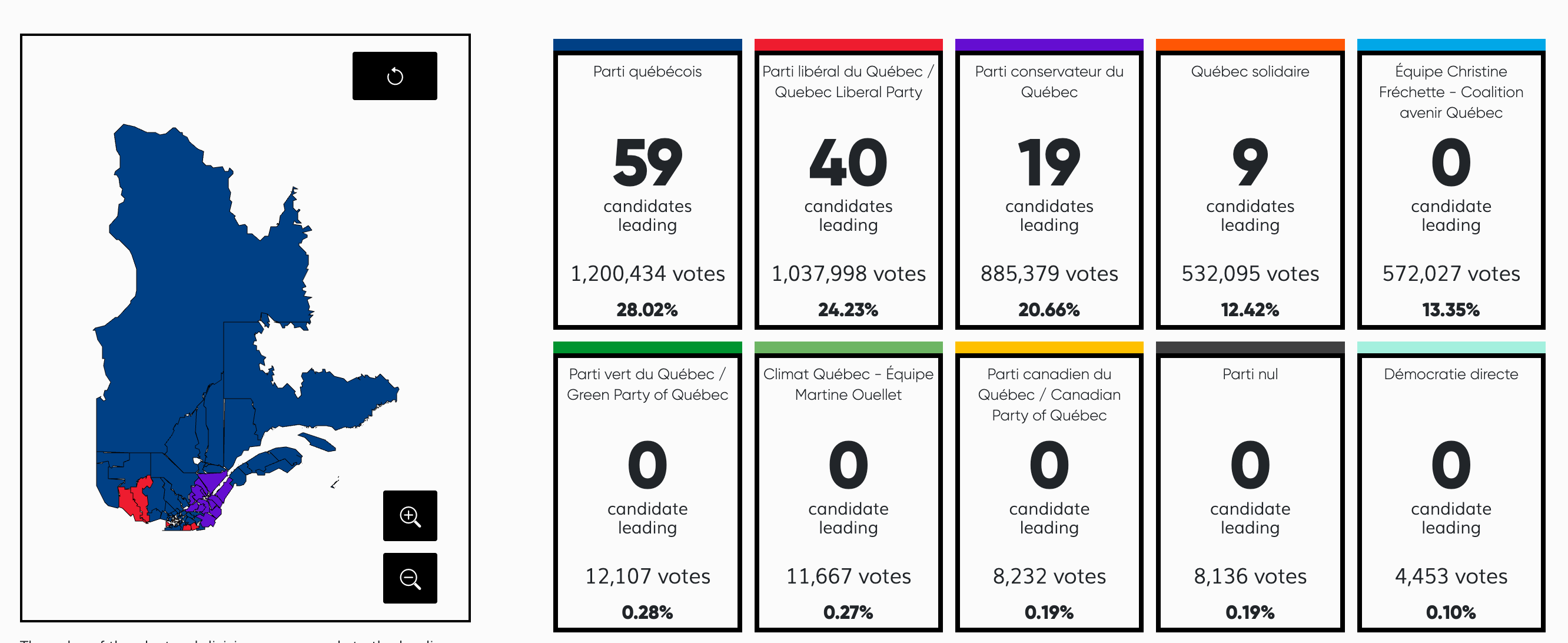
It is easy to explain the fundamental unfairness of a system where over half a million people can vote for a party and that party can come away without any seats whatsoever. Easy, that is, if we accept the premise that voters vote for parties and not candidates. In this election, the vast majority of voters almost certainly did vote for party rather than candidate.
As always on this question, we have to ask which problem we want to solve. Is the problem that voters are not getting the party they voted for? Or is the problem that voters are voting for the party rather than the candidate?

Our system is designed and built around the concept of local representation. We are meant to elect representatives who go to the province or nation’s capital, make common cause with other representatives, and solve our local and collective problems.
There are three fundamentally different approaches to electoral reform. The first is the status quo — which generally wins only because nobody can agree between the other two and among all the possible solutions within each:
Proportionality — the idea that 28% of the votes for a party should get them 28% of the seats — is the most common solution offered, and dispenses with any pretence of representation. If being a well enough connected member of a party is the only requirement to obtaining some or all of those seats, there is no incentive, no reason, to connect with constituents rather than simply with demographics, or to ever call their own party to account. Party loyalty is strengthened, but independent thought and discourse is discouraged. In such a system, ‘representatives’ represent the government to the people rather than the other way around.
In a proportional system, the party with 28% of the vote leading the government is also normalised. Adoption is also complicated by the numerous different proportional systems available, with top-up systems, multi-member ridings, mixed membership, pure lists, and subvariations within those concepts. Even a broad consensus will often fail on the technical debate that follows.
Preferential voting — the idea that each voter has an order of preference among candidates — largely solves the problems we see in Canada’s elections today, but is not generally favoured by any political party because it breaks the bond of loyalty between voters and their party, while preserving and strengthening local representation. You do not get the most liked or most popular candidate in such a system, rather you get the least dis-liked. Like proportionality, the subvariations are numerous, and using different counting algorithms can produce different results from identical ballots. The status quo, then, wins by default.
Quebeckers will need to decide what matters more — partisanship or representation, and ensure that the minority parliament takes their views into consideration if they move forward with electoral reform. Governments considering reform often cop out of their own obligation to research and evaluate the question by deferring to some form of Citizens Assembly rather than assuming their own role as the deliberative body whose specific reason to exist is to perform that exact function.
The quirk of the current electoral system giving the Conservative Party of Quebec no seats in 2022 and the Coalition Avenir Quebec no seats in the 2026 election on very similar vote counts raises another important question. As the former governing party, wiped out in seats but not in votes, is the CAQ entitled to any form of existence in the National Assembly?
When Frank McKenna won every seat in the New Brunswick legislature in 1987, the opposition was still granted some budget and power to ask questions as even the unanimous government understood that there still needed to be some form of opposition for our democracy to remain functional. While I have seen calls for similar treatment for the CAQ, it is worth noting that, unlike 1987, there are three opposition parties in the legislature, and so there is no reason to offer any special consideration to the CAQ. Democratic opposition is not compromised by their absence any more than it was by the provincial Conservatives not having any seats last time around.
The most interesting challenge ahead, though, for the Quebec class of 2026 will be in how to handle the question of a referendum on independence. Québec Solidaire is a progressive, left wing party with a lot of good ideas. Unfortunately, independence is also a top-line priority for them, making them completely unsupportable for anyone who believes, as I do, that, in large part, Quebec’s strength is Canada and Canada’s strength is Quebec. Parties whose core purpose is the breakup of the country cannot by their nature cannot be redeemed by lesser policies.
A lot of QS’s supporters are oblivious to the fact that they are a diehard separatist party, with 150 prominent Quebeckers, many of them federalists, signing an open letter endorsing the party on progressive grounds. The PQ’s separatist strategy is to hold the threat of separation over the federal government in order to extract ever more concessions rather than to ever actually achieve independence — for them, success is failure — but QS has a completely different reason and approach on the question.
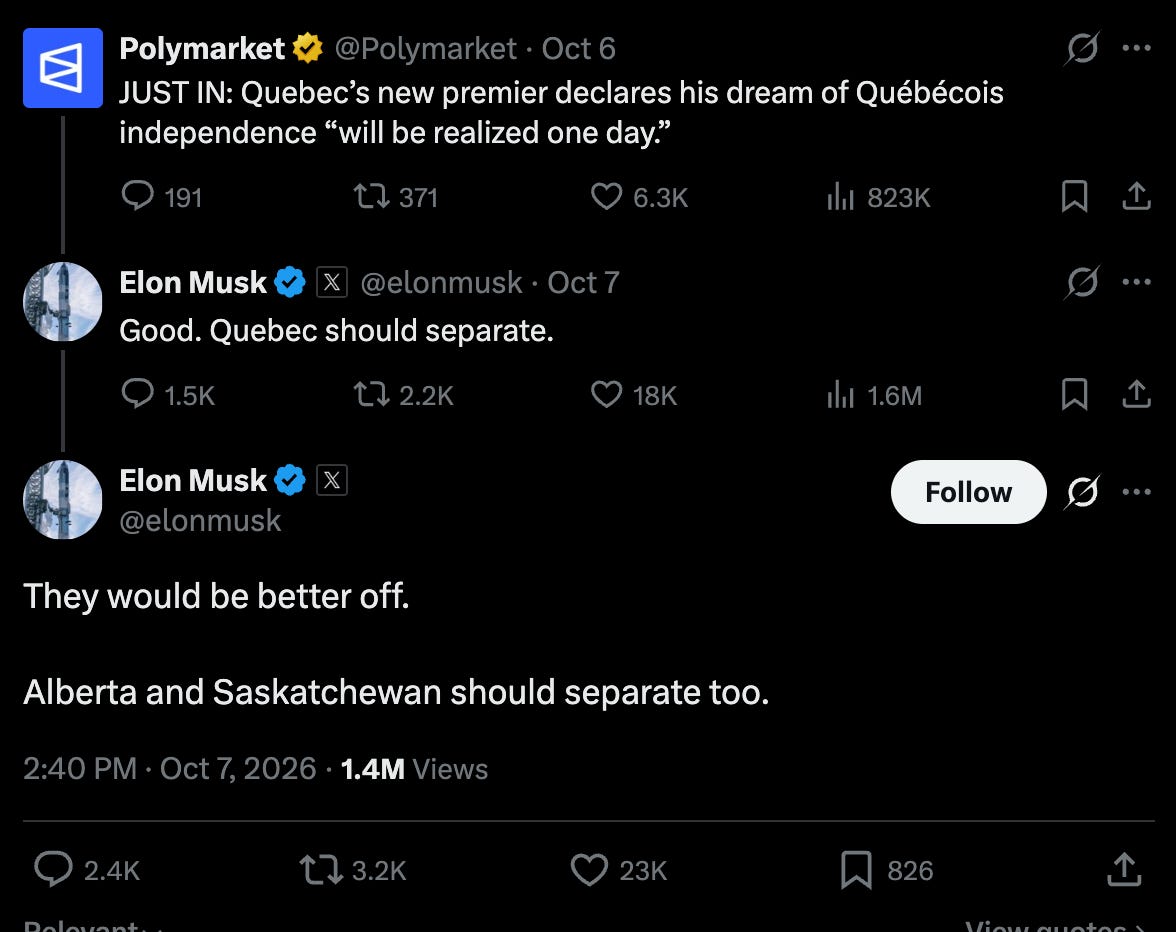
The balance of power may not bring us to a referendum, but QS will call the PQ’s bluff and force them to be ever more explicit on their aspirations for independence, as much to establish QS as the separatist option as to actually achieve separation for its own ends. Where they’ll take us from there is toward trouble on national unity that we cannot afford at this moment in time. It is not by accident that the Alberta separatists are celebrating the PQ’s win — and Elon Musk is championing their cause.
The PQ is paying lip service to Quebec’s minority anglophone population, with premier-designate Paul St-Pierre Plamondon having committed during the campaign to make many of the anti-English laws in place more rational and effective rather than symbolic, and promised to be a premier for all Quebeckers. As long as this is alongside a commitment to attempt to break up Canada on ethnolinguistic lines the moment Trump leaves office, it is hard to take that as a serious offer.
I left Quebec — for the second time — after my electoral defeat in 2019, but I was born and raised in the province. The minority parliament that the province has selected to be led by a separatist government in the face of the most popular and stable federal government we have had in my lifetime, and next to the most dangerous and unstable United States we have seen in two centuries, will face numerous crossroads.
It is hard to predict where the province will head, but one thing I am sure of is that there is change coming. Whether it is for the best remains to be seen.
PSPP talks a good game regarding minority/Anglo rights but his promise to harden some laws - like applying Bill 101 to CEGEP enrolment - makes it hard to believe that he will do anything to ease the huge burdens imposed on us through the CAQ's increasingly racist laws. Also, PSPP has changed his stripes so many times over the years, he can't be trusted to care about anything or anyone except his own lust for power. Remind you of anyone else we all know?