


A vote for the Parti Québecois is a vote for Donald Trump, yet Quebec is on track to embrace that outcome with enthusiasm in next week’s provincial election.
With their commitment to separation, the PQ’s desire to weaken and undermine Canadian confederation, in the face of an existential threat from south of the border, will not benefit Quebec nor defend their version of the French language or culture. Their arrival in power with a promise of a referendum will not strengthen Quebec’s social fabric, its economic outcome, or its collective future.

The sovereignty that the province would gain would be ephemeral, a fleeting moment of autonomy before coming to terms with their lack of natural allies in an unstable world. They will be forced into the hands of the Americans who will make short work of their language, culture, and economy.
The problems are institutional, at the core of Quebec society and its government. Elections Quebec, the ostensibly non-partisan agency whose very existence is to ensure the fairness of the election, is putting its own thumbs on the scales.
The Quebec Liberals are polling at 23 percent, but only 11 percent among francophones. They are a long way from having serious credibility among the francophone voting population, and it is getting worse for them as anti-immigrant feelings increase throughout the province. That is a political problem the PLQ needs to address on messaging, on substance, on campaign strategy, on having the courage of their convictions after spending year after year, generation after generation, equivocating on their purpose as a political party, on their views of Quebec within — or without — Canada.
They fall into the traps laid for them by the separatists, regularly avoiding saying anything that might irritate the separatist billionaire running Quebecor, Quebec’s very own Fox network, as if equivocation will gain favour from him or his media empire.
The party relies on its default position among minority voters and the small segment of the francophone population that remain hardline federalists. They do not have the courage to stand up and say the truth: Quebec’s strength is Canada. Canada’s strength is Quebec. That defending French is not a zero-sum game, that Quebec has a role in defending and promoting French across the rest of Canada, of assuring the place of French in the world as a whole.
And it is here that Elections Quebec enters the picture. They have been systematically attacking minority voting rights through this election cycle. Their actions have been condemned and overruled by the province’s own courts. They refused to put English on voter information cards. They are requiring proof of entitlement to English language services at voting stations.
If an individual poll clerk does not speak English, that is one thing. The sheer number of poll clerks required makes it entirely likely that many if not most will be unilingual. We can reasonably believe that some communities will not have anyone who speaks English available to work in a polling station, and, in all likelihood those communities will also have few English-speaking voters.
If, however, the agency that runs the election tells the clerk that they may not speak English to a voter without verifying their license to communicate in English, that is deliberate voter suppression, and should be seen as the illegal act that it is. Every person employed at a voting station should be willing and able to offer service in any language they speak, whether it be French, English, Kanienʼkéha, Yoruba, or Vietnamese. That English-speaking voters are specifically targeted is to interfere and impede with their ability, and therefore their right, to vote.
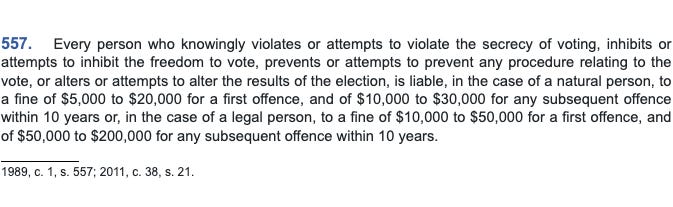
The provincial Liberals are the only provincial party polling strongly among anglophone and other minority voters. The politics of that are irrelevant. Their ability to win a general election — or lack thereof — equally so. The decision of Elections Quebec to interfere with minority voters is to forego their own neutrality, to take a side in this election, to disproportionately impede support for one particular party, to put their thumb on the scales.
In a province where the legislative assembly unanimously agreed, across party lines, that “bonjour, hi!” was an unacceptable greeting in a store, they have taken it a step further, requiring the provinces anglophones not only to prove their identity, but prove their right to service in English before being granted that service — and at that, only with a court order. Yet somehow, Quebec’s nationalists do not see the similarities between their movement and the ethnic nationalism destroying the United States.
The active and deliberate suppression of a particular type of voters is similar in intent to the actions of Republicans across the United States, who use gerrymandering, resource allocation, geography, and criminal law to suppress Democratic votes. Doing so along ethnic lines, to favour one ethnicity to the exclusion of others, puts Quebec’s separatists in the same category as the white supremacist MAGA movement they claim to despise.
Yet, it has to be said, it has to be repeated, it has to be emphasised, that undermining Quebec as a foundational part of what Canada is will destroy Quebec’s own weight, its own autonomy, its own sovereignty, in the face of an existential military and economic threat that shares a massive border with the province.
American strategy is to divide and conquer Canada. Danielle Smith is helping Trump divide Canada from the West, and Paul St-Pierre Plamondon is helping divide Canada from the East. Both would do well to remember the second half of that strategy.
As a rural Anglo Quebecer I have felt disenfranchised for many years. The CAQ has succeeded in institutionalizing this. There has been a race to this end for generations now and the PLQ has rarely stood strongly against it - including often voting against its own interests on angry motions such the bonjour-hi controversy(!) to help pass them unanimously. The way to fight nationalism is never through appeasement but through standing tall and making the case strongly and sincerely. The federal government has failed us miserably on this count here in Quebec through this latest surge of xenophobic nationalism and is also failing us in Alberta.