


Canada is facing an existential threat from an unhinged neighbour intent on destroying our sovereignty to plunder our resources. The Alberta separatist movement is not some great defender of either; they are useful idiots to those who threaten our country.
The province’s small but noisy separatist movement are woefully misinformed. It would be far worse for Alberta than for the rest of Canada if they were to walk away from confederation and try to go it alone.
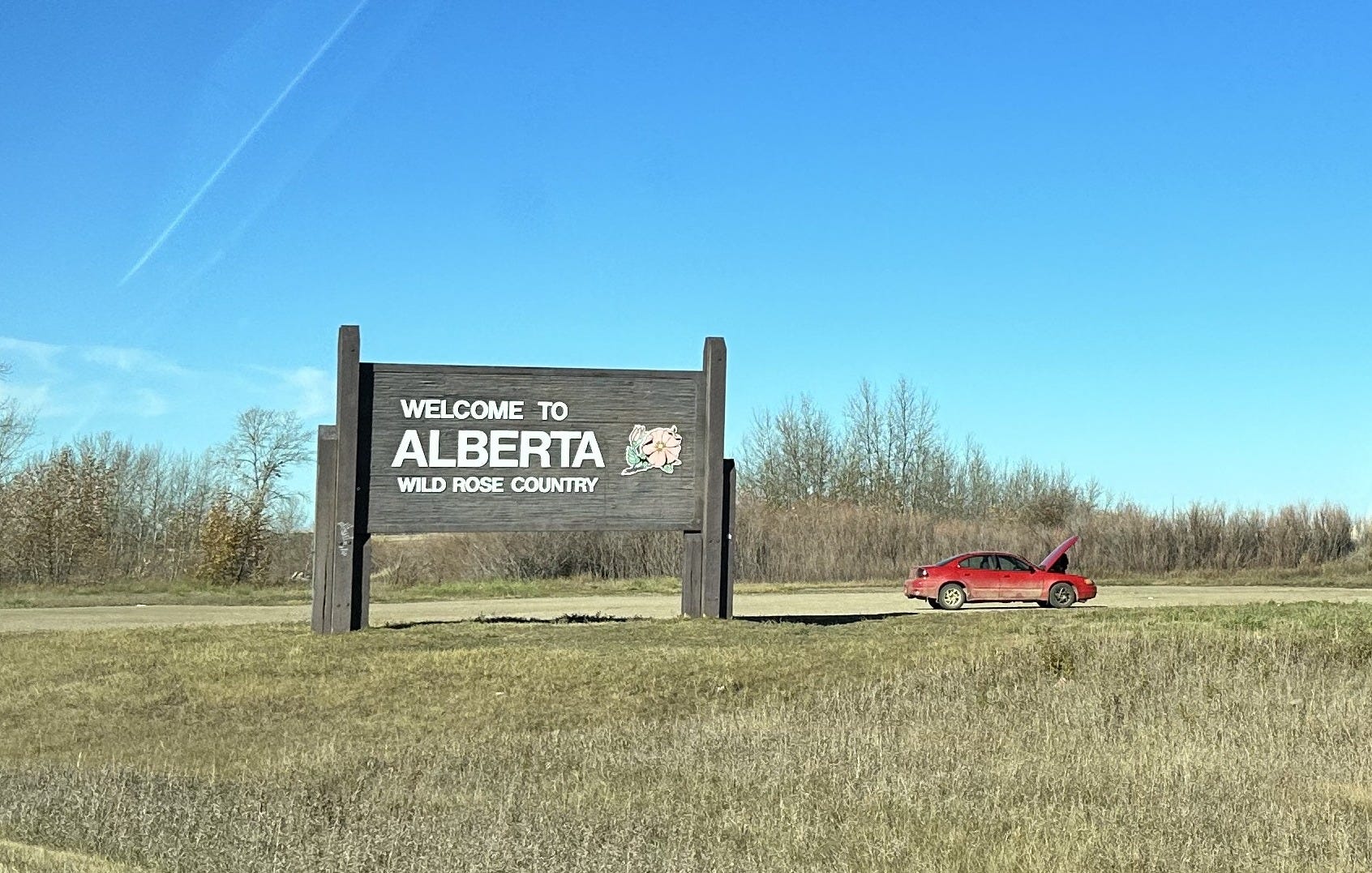
I moved to Alberta in the spring of 2020 and inadvertently spent the COVID years in the province, moving again to New Brunswick at the first opportunity a little under four years later. In my haste to leave, I received a speeding ticket just a few kilometres short of crossing into Saskatchewan.
The rampant ‘Fuck Trudeau’ signs and flags, the lifted trucks putting out thick black smoke in what they called rolling coal, and a featureless, soulless landscape east of the mountains were not to my taste. I often described Edmonton, where I lived for those years, as being like West Palm Beach — but without the palms or the beach. It was a land defined by endless multi-lane grid roads and strip malls. For some, that is what freedom means.

There was a specific moment I knew I was done with Alberta. My parents were visiting us from Quebec. My father and I had walked to a nearby Asian grocery store and were waiting to cross 97th St NW at the Griesbach Parade crosswalk in the spring melt. A black lifted truck with its usual Canadian and Fuck Trudeau flags putting out black smoke swerved toward us to run through the small puddle at the base of the cross walk, soaking us from head to toe and muddying the food we had bought. For me, for my experience in the province, that symbolised Alberta culture in a way I could not fully identify until that moment.
The independence movement is driven by those people, and the politicians who lean on them for support. They believe the province contributes more to Canada than they get back, that the liberal elite from the rest of the country are out to get them, and that being part of confederation offers them nothing of benefit.
While years of Alberta Conservatives running the federal government actively hindered the development of the oil industry, it was a Liberal Prime Minister with essentially no support in the province that spent immense political and raw capital to buy and expand the Trans Mountain pipeline to help Alberta get their oil to foreign markets. They demand endless federal support to sell a product that they also claim to be wildly profitable, expecting to nationalise the costs and privatise the profits.
If they think it is hard to get Alberta oil to tidewater today within Canada, imagine being a landlocked, independent, nation.
To the east, north, and west would be what is left of Canada, a country jilted by the departure of the province from confederation, who would have no interest in buying Alberta’s oil at international market rates. Moving oil across British Columbia to the coast for export would not be in BC’s interest; aside from managing environmental risks to the west coast, it would be increasing competition with their own demand. There would be no internal Alberta counterweight within Canada to look for compromise.
With no outlet, no access to a coast, Alberta would be forced to sell their oil at a greater discount to Canada than they do now.

To the south, the United States would not have any greater interest than Canada in helping the independent nation of Alberta increase their oil revenues. Indeed, the American funding of the separatist movement should be a red flag for those who want to separate. Why would the Americans be interested in Alberta leaving Canada? What would they get out of the deal? Hint: it isn’t to get two more red Senate seats.
For the province most sympathetic to Trump and the MAGA movement, they might believe that an independent Alberta would naturally become a US state. Thinking this way would be folly.
The United States would want to control the small oil-producing country, but they would have no incentive to integrate it. Having them nominally independent, but captive, would drive its oil prices down, making them a cheap source of energy for the Americans. Oil-producing countries like Iraq and Venezuela have not been the focus of American military intervention for the purposes of political integration, after all.

Alberta has not done a good job of managing the oil revenues they already have. After fifty years, the province’s sovereign wealth fund, designed to invest the revenues from its non-renewable resources, has just over $31 billion. The province initially charged 30% resource royalties to contribute to the fund — but eliminated those by 1987 while the provincial debt is about to hit $90 billion. Norway, whose oil production is about half of Alberta’s, has a sovereign wealth fund approaching $2.75 trillion in CAD — around 90 times that of Alberta, and more than twice their own national debt — and it was only established in 1990, 14 years after Alberta’s. Alberta’s problems are not caused by Canada — they are caused by Alberta.
This poor understanding of money, exemplified by the millionaire-for-a-day culture of expensive modified pickup trucks and toys in an unstable economy, explains why Alberta separatists are willing to sell out to the Americans for the relative chump change of $500 million — a loan at that.
As a practical matter, achieving the pyrrhic victory of independence is easier said than done. Bill 14 allowing a referendum has already been ruled unconstitutional. More to the point, every inch of Alberta territory is on treaty land. Specifically, treaties 4, 6, 7, 8, and 10. Any negotiations would have to involve each of those communities. Given the risks, don’t expect Canada’s Indigenous population to be champing at the bit to give away their treaty rights.

It should be understood in such circumstances that if Canada is divisible, so are its constituent provinces. Even if Alberta were to find a way to start a process of separation from Canada, there is no presumption and certainly no guarantee that the entire province would go. Every inch of the province would be up to trilateral negotiation between the provincial government, the federal government, and the Indigenous peoples whose treaties cover those lands.
A divided, broke, and economically and geographically landlocked province like Alberta would not fare well on its own, and would be easy pickings for our resource-hungry authoritarian neighbour. It is not a surprise that they are manipulating Alberta’s far-right into a separatist movement that serves nobody’s interests but the Americans.
Excellent analysis, David but so depressing…
Thank you for providing so many interesting links, particularly The Democracy Defender, that gives chapter and verse of the forces aligned against the better interests of Canada and the world - with Stephen Harper one of the kingpins.