


Alberta is in the midst of a 10-part referendum on whether or not to hold a referendum while Quebec is in the midst of a provincial election that will decide whether they hold their own, in their case, third referendum on whether or not to separate the whole, intact provinces from Canada.
The underlying assumptions of both provincial separatist movements is that, while Canada is divisible into its constituent provinces, the provinces themselves are immutable on their current boundaries. Irony, apparently, is not their strong suit.
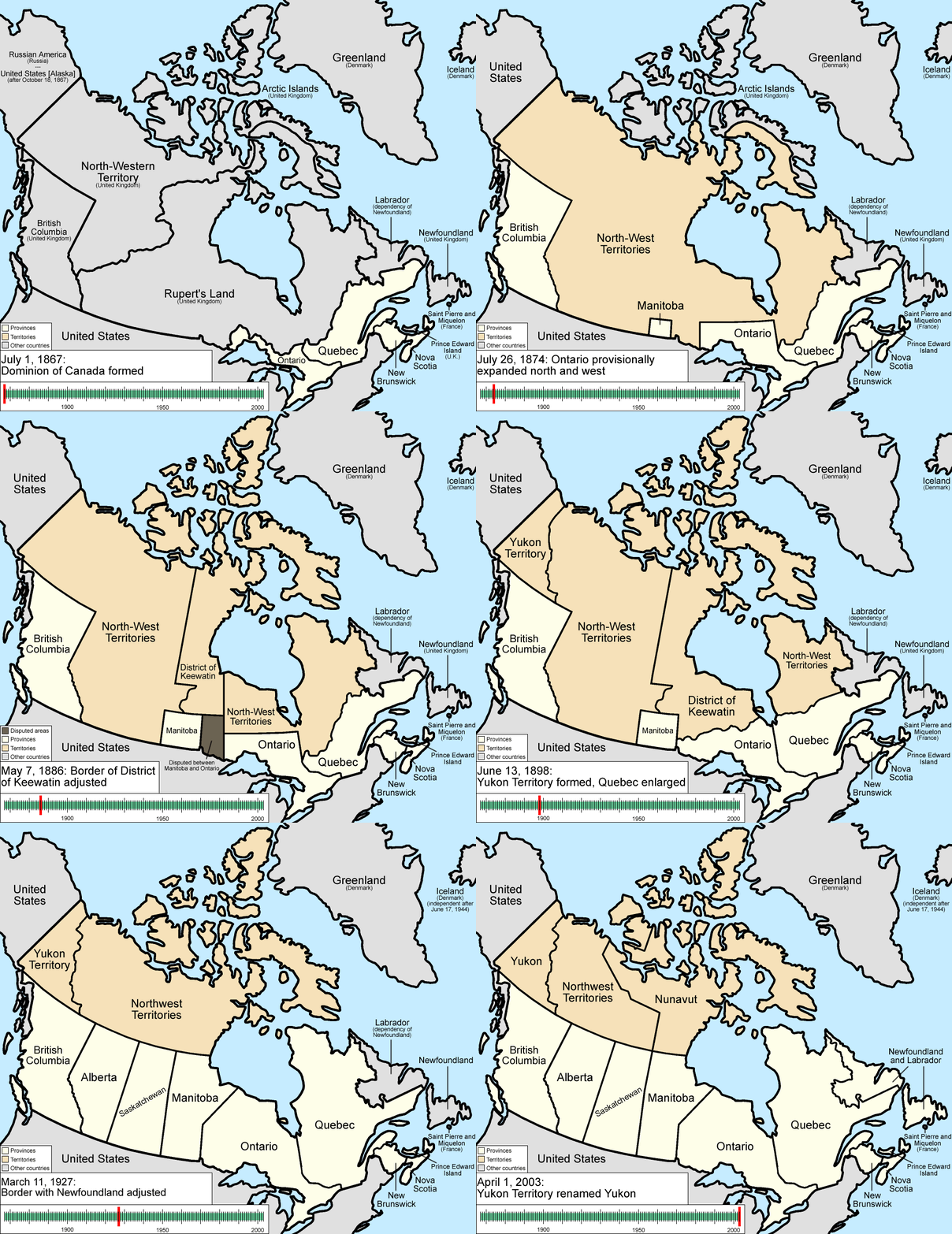
The first assumption is false on its face. Alberta exists as a collection of treaties between Indigenous nations and Canada, over which a more or less square province was unceremoniously overlaid after the fact with little regard for those treaty boundaries.

Quebec, at the time of Confederation, consisted of barely half of the territory it covers today. It is not a permanently defined territory in a way that would necessarily survive a declaration of independence, though it does not share Alberta’s treaties barring any path toward legal separation.
It begs the question of what a a separate Alberta or Quebec might look like? A quick look at the 2025 electoral map released by Elections Canada shows that Canada’s electorate does not reliably vote along provincial boundaries. Political opinion within each province is not any more uniform than it is in the country as a whole.
If either province declared independence, on what grounds could the ostensibly sovereign governments of Quebec or Alberta state that, say, the entire island of Montreal or the City of Edmonton could not unilaterally declare their own independence, in turn, from those countries?
Montreal as a nation-state could be a formidable country, bearing a powerful economic engine of its own, with its own air and seaports right on the island. It already fills the roles of both the culinary and cultural capital of Canada. Shedding the shackles of Quebec City’s oppressive governance might allow the Greater Montreal Area to thrive, to become our own region’s Singapore, one bonjour-hi at a time.
The Indigenous majority occupying the half of Quebec that was not a part of the province at the time of Confederation, too, could elect to stay in Canada or go their own way altogether. Quebec could leave Canada — but Canada would also leave Quebec. What would be left? Separation is a Pyrrhic victory for its supporters.
A Canada that concurrently lost two provinces would no longer be a functional country — which is what the traitorous Trump-loving Alberta separatist leaders want in the first place — and its dissolution would open the door to a reimagination of our political boundaries.
Alberta’s final disposition is just as unclear as Quebec’s. Support for separation is significantly lower there than it is in Quebec. In spite of the city’s reputation, support is lower in Calgary than anywhere else in the province, according to an Ipsos regional breakdown this summer. If the regions that opposed separation opted to separate from a separate Alberta, that nascent country, too, could find itself without any major urban centres.
Edmonton’s Anthony Henday and Calgary’s Ring Road could just as easily become international boundaries, modern moats against ill-considered foreign-funded disinformation-led separatist movements. Lloydminster, the city that straddles Alberta and Saskatchewan, could decide that border checkpoints down the middle of 50th Ave are less useful than ones west of town.

There is nothing sacrosanct about provincial boundaries when it comes to separation. The people in the provinces have the freedom to move into or out of each, and the boundaries themselves would be up for discussion and negotiation as well.
The trouble is that few people are saying this part out loud. We assume that the comfortable realities we have will hold because we believe them to be permanent and immutable. Political discourse in this country accepts the premise that Quebec and Alberta can discuss independence as whole provinces without consideration of the malleability of their own boundaries.
The separatist narratives of both Alberta and Quebec rely on fundamental underlying assumptions that have no basis in reality, yet we are not reliably calling them out on this.
The fact is that if Canada is to be divisible, so are its constituent provinces.


Nothing like tossing a cat in amongst the pigeons. Thank you David for this post. I had thought, during the Quebec referendums that they should be allowed to leave with the territory they arrived with, or even leaving the south shore behind, but had not yet thought of applying that to Alberta.
Thank You!
I reference books that reference the The 1995 Cree Referendum in the following article. I wasn't aware of it at the time, and I believe these separatists movements would be understood differently if they were based on facts rather than only emotion (White grievance culture.)
https://r.flora.ca/p/if-canada-is-severable